Check out new preprint titled ‘Reaction kinetics of procainamide dye derivatization of N-linked glycans to enable robust process analytical workflows for glycoprotein-based biologics manufacturing’ led by and that is available online. Congratulations to them both. This paper was a culmination of Huda’s hard work after a year long internship in the lab. Best of luck with wrapping up your degree back in the UK and future endeavors in the pharmaceutical/chemical industry!
https://www.biorxiv.org/content/10.1101/2025.10.15.682640v1
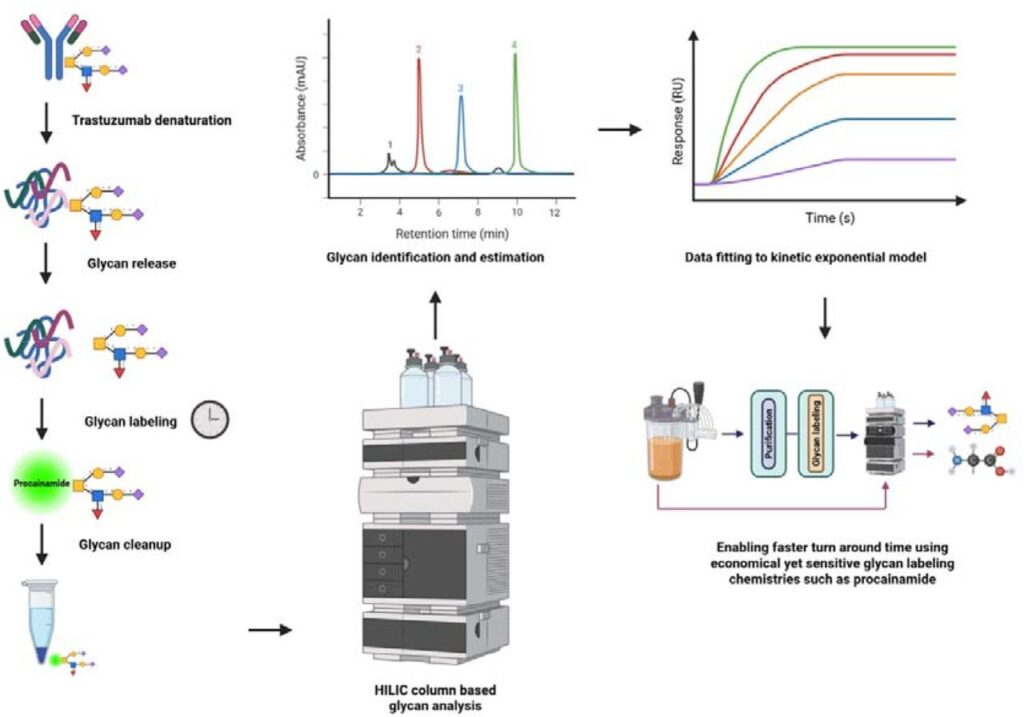
Abstract: N-glycosylation is a post-translational modification of proteins that represents a critical quality attribute (CQA) for therapeutics like monoclonal antibodies (mAbs), directly affecting drug efficacy, safety, and stability. Real-time CQA monitoring analytical platforms depend on rapid N-glycan release and fluorophore labeling chemistries to support automated bioprocess analytics during mAb manufacturing. Procainamide is a well-known fluorophore used for released N-glycans reducing sugar aldehydes labeling that offers both high fluorescence and mass spectrometry detection sensitivity comparable to several commercial reagents available in the market. However, currently there are no studies that optimize its use and long incubation times are often reported in the literature for procainamide labeling of N-glycans that has limited its use in time-sensitive workflows relevant to various stakeholders in industry, academia, and regulatory agencies. Here, we have systematically determined the combined procainamide labeling via reductive amination/reduction reaction kinetics at various incubation intervals, ranging from 1 min to 12 h, using N-glycans isolated from model biologic glycoprotein trastuzumab (TmAb). Labeling efficiencies were quantified using high-performance liquid chromatography with fluorescence detection (HPLC-FLR), and detailed reaction parameters were determined by fitting suitable kinetic models. Results indicate that most N-glycans reached over 95% labeling efficiency within 1 hour at the desired reaction temperature. Interestingly, N-glycan structural features, particularly galactosylation and fucosylation levels, significantly influenced the labeling reaction rate. Fucosylated glycans exhibited up to 4-fold higher reaction rate constants than non-fucosylated forms, whereas increased galactosylation levels was associated with slower reaction rate. These results provide essential kinetic benchmarks for incorporating procainamide labeling for released N-glycans, and facilitating more efficient analytical workflows for Process Analytical Technology (PAT) focused on biologics N-glycan analysis in both research and industrial settings.